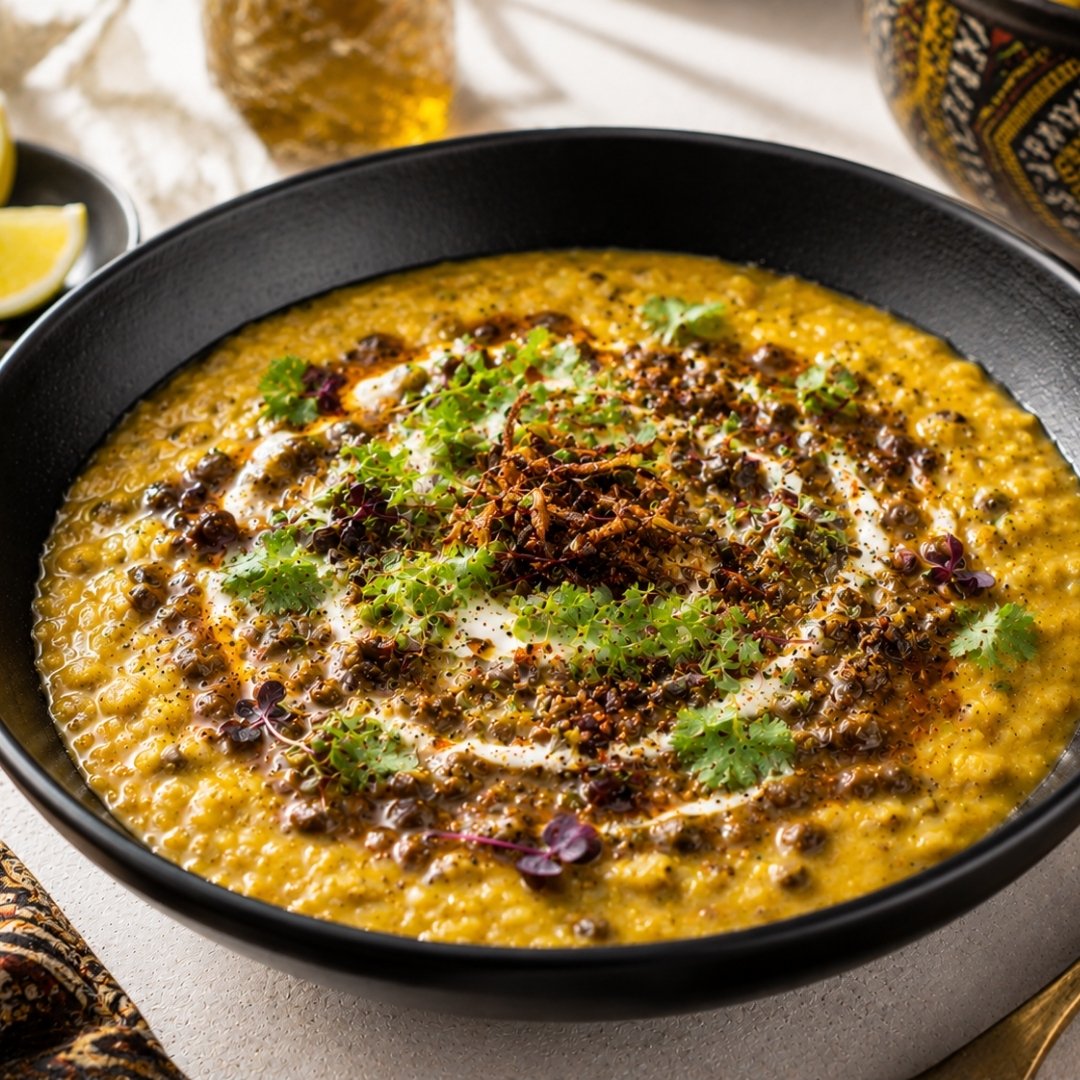
The dal makhani reaches the table the way important guests arrive — slowly, announced by its own perfume. Dark as monsoon earth, glossy on top, a swirl of cream sinking into it like a signature. Steam rises with that unmistakable smell: butter warmed until it turns generous, smoke somewhere underneath, spices humming low.
Hands move immediately. Bread is torn. Somebody ladles with the confidence of a person who has never once read a label.
But watch the far end of the table.
There is one person there who ordered this dish — it was their voice that said dal makhani to the waiter, quickly, almost before the menu was open — and who is now eating it in the smallest spoon the restaurant owns.
"I'll just taste it," they said.
The first spoon happens early, while the dal is still too hot, because they could not help it. Watch their face. The eyes close for half a second. Something in the shoulders comes down, some meeting adjourns. Then the eyes open, and they say, to no one in particular, "It's quite rich, no?" — as if filing a small complaint against their own happiness.
The others are not filing complaints. The others are conducting a heist. One of them announced fullness ten minutes ago and has since eaten from three plates, including the makhani-streaked corner of somebody's naan. Two are dividing "the last of it" into halves that would not survive an audit. Nobody at this table is behaving with dignity, and the dal is entirely to blame.
The person at the far end stirs. Stirring, it turns out, can look a great deal like eating without being any.
It is worth pausing to remember what kind of food is sitting in that bowl. Dal makhani is slow food — the slowest, really. Somewhere, generations before us, this dal cooked through the night, and a pot that simmers overnight is never alone; someone always stayed near it, feeding the fire, skimming, tasting, keeping watch. Long before it is a dish, dal makhani is a vigil. A thing that takes all night to become itself deserves a table that is in no hurry either.
And our person is in no hurry — but look closer, and the slowness is not savouring. It is arithmetic. Each spoonful is being weighed on a scale nobody at the table can see, against numbers read years ago in a magazine, a forwarded article, an advertisement with a measuring tape in it. Somewhere along the way, rich stopped being a compliment paid to food and became a warning printed on it. "Sinful." "Guilty pleasure." "I could never." Listen to that vocabulary carefully. None of it was invented at a family table. It came from outside, in someone else's voice, and it has been renting space in this person's head ever since — without once paying for dinner.
The second spoon comes late, and it is smaller than the first, which should be illegal.
It is a pity, because there is so much in that bowl to slow down for. The masala underneath this dish is a crowd scene: at its base, sendha namak — pink rock salt, the salt Indian kitchens traditionally reach for on fasting days, which is its own quiet joke, because the person at the far end is essentially fasting at a feast. There is amchoor, the sourness of unripe mango, which the old texts prized as the sourness that awakens taste and brightens a heavy dish. And beneath these, some twenty whole spices, roasted and ground, many present at barely a third of one percent each — nutmeg, which tradition calls the spice of rest, mace, both cardamoms, saunf, the gentle digestive of the Indian kitchen, star anise, tej patta, nag kesar. Whispers, individually. Together, the entire low harmony under the butter.
The recipe even keeps its own promises. The salt in that masala predicts about 21,800 milligrams of sodium per hundred grams of the blend; a laboratory, walking a completely different road, measured 21,376. Two independent routes, arriving within two percent of each other. (And a masala is the seasoning, never the meal — a spoonful of it disappears into a whole pot, the way a signature disappears into a letter.)
The third spoon is the strange one. It happens when the bowl is nearly empty, when the heist crew has moved on to arguing about dessert. The person takes it slowly, deliberately, and there is something in their face that is not restraint at all. It is closer to farewell.
You have seen this person. Perhaps across the table from you, many times.
Perhaps from considerably closer than that.
Because you know exactly how the third spoon tastes when you have spent the whole meal guarding against the first two. You know the private arithmetic, the small spoon, the "I'll just taste it" said in a voice you eventually recognise was never yours. And you know the tell that gives the whole game away: nobody rations a thing they are indifferent to. You ordered it. You always order it.
"Taste is the only sense that crosses the threshold. You do not just sense it — you absorb it. The outside becomes the inside." There is, in other words, no such thing as just tasting.
And what you have been measuring out in three careful spoons was never the cream. It was the celebration.
So here is the release, and it is not permission — permission is just the diet speaking politely. It is this: dal makhani does not need an occasion, and neither do you. A dish that once kept someone up all night can keep a perfectly ordinary Tuesday company. A whole bowl. Your own bread. People you already have, stealing from your plate, claiming to be full. Do not save the celebration for a day worth celebrating; season the ordinary days until they are.
Forward this to the one who orders the dal makhani and then eats three slow spoons of it, watching everyone else finish theirs. Sit them in front of a full bowl on a day that is special for no reason at all. Kya pata kal ho na ho.
Happiness is health.