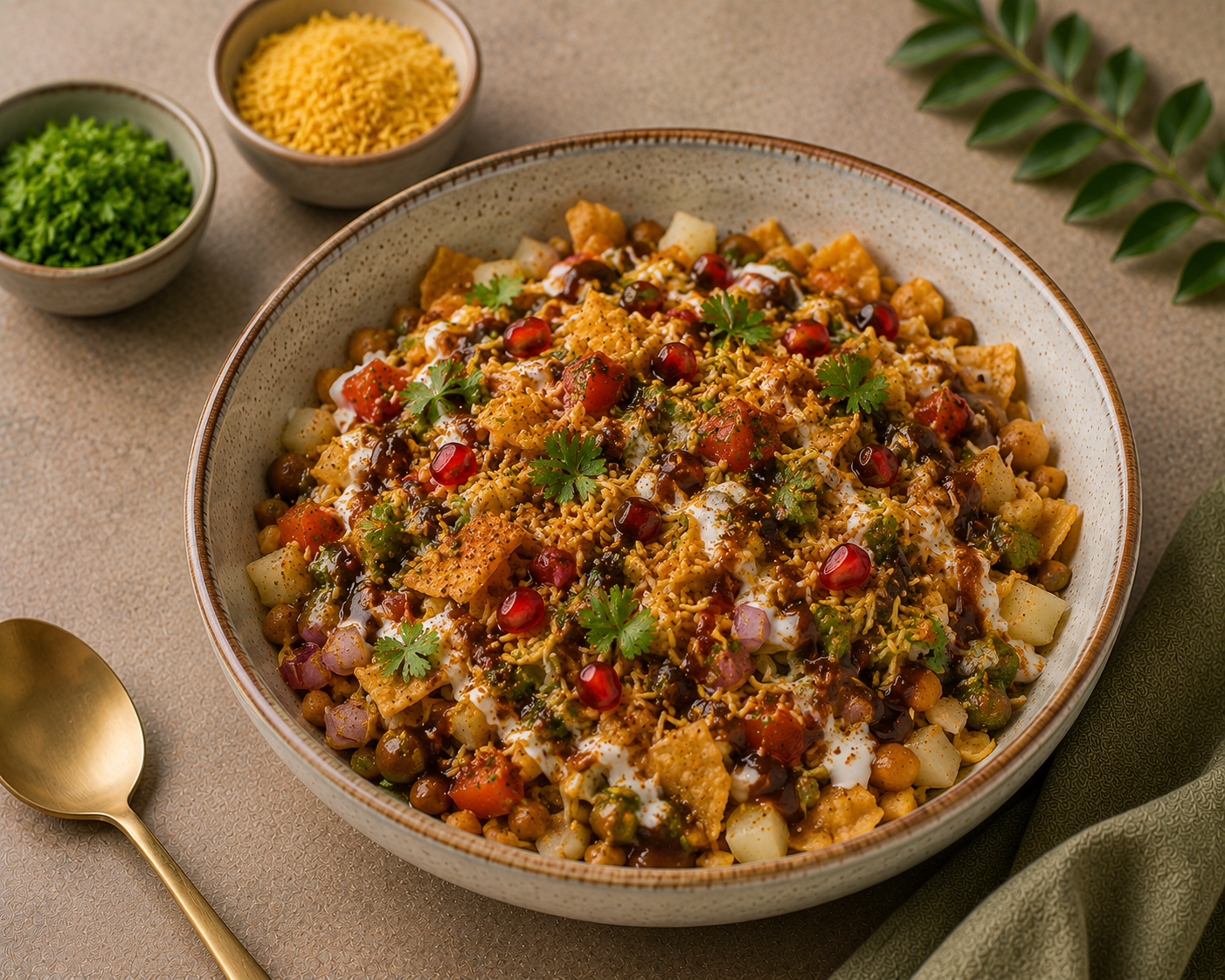
Try to remember the first money you were ever trusted with. Not pocket money counted into a drawer — money with a mission. Ten rupees, maybe, pressed into your palm with instructions to come straight back. And you did come straight back. Eventually. Minus ten rupees, plus one paper plate's worth of evidence on your breath.
Because you didn't walk past the chaat cart. Nobody walks past the chaat cart. The chaat cart is where straight lines go to die.
You can still see it if you close your eyes. The man behind it working like a one-man orchestra — a puri cracked with a thumb, a spoon of this, a pinch of that, a flick of green chutney, a flick of red, curd falling in ribbons, and then the final dusting of masala thrown from a height like he was blessing the plate. He never measured anything. He never got it wrong.
And you stood there — small, solvent, unsupervised — and ordered. Yourself. In your own voice. "Thoda teekha." Or "extra meetha," if that's who you were. That plate was the first document in the world with your name on it.
Then you went home, and somebody smelled it on you, and a word arrived. Junk. Or its more respectable cousin, delivered in a very specific tone: "outside food." You know the tone. It doesn't describe the food; it sentences it. The tone was never yours — it was handed to you, the way tones are, by people who had been handed it themselves. You wore it because it came from voices you loved.
Here is the part you are not supposed to notice, so let's notice it gently.
Go to any wedding. Walk past the seven-course counters, the live pasta station nobody asked for, and find the chaat counter. Now look at who is standing first in line. It is the same aunt who says "junk" the way other people say "smuggling." It is the uncle who has been eating for his health since 2004. It is your own mother, holding a plate, saying "just a little, only to taste," while the chaatwala builds her a third round.
You could call it hypocrisy. It isn't, quite. It's love that has been told to be ashamed of itself, sneaking out through the one door that's socially permitted — the wedding, the occasion, the "just this once." Watch their faces at that counter. Nobody looks guilty. Everybody looks eleven years old.
And what is this dangerous substance, exactly? Look inside a chaat masala and you find something closer to an old apothecary's shelf than to anyone's idea of junk. Nearly a third of it is kala namak — the black salt Ayurveda regards as the best among salts, with a cool potency the old texts call gentle on the stomach. Another third is amchoor, dried unripe mango, which the classical tradition prizes as ruchya — the sourness that wakes up the tongue and brightens a heavy dish. Salt and sour in almost equal measure: that's the famous first slap of chaat, decoded.
Then the supporting cast walks in, and every one of them arrives with centuries of paperwork. Imli, bringing its dark sweetness and a respectable share of dietary fibre. Roasted jeera, which the Nighantu tradition describes as deepana and pachana — the spice that kindles the digestive fire and helps digest what's eaten — and which, the food-composition tables add with a straight face, carries around 14 grams of protein per 100. Sendha namak, the pink salt trusted enough to be eaten on fasting days. Red chilli, black pepper — the Bhavaprakasha's "sharp spark that opens digestion." Pudina. Awla, honoured in Ayurveda as a rasayana. And soonth, dried ginger, which the Charaka Samhita calls vishva bheshaja — the universal medicine.
Eleven ingredients. The tradition that seasoned your "junk" spent two thousand years writing admiring notes about every single one of them.
None of this makes chaat a prescription, and it doesn't need to be one. It only needs to be what it always was: sour, hot, sweet, cold, crisp and collapsing, all on one plate, all at once — the most honest food in the country, because it hides nothing and apologises for nothing.
"Taste is the only sense that crosses the threshold. You do not just sense it — you absorb it. The outside becomes the inside."
Maybe that's why "outside food" was always the wrong charge. The outside was the whole point. Outside was where you stood on your own two feet with money in your fist and made your first independent decision, and the decision was delicious.
Because it was never junk. It was the first food you were ever trusted to buy alone — and what you tasted that day, under the salt and the sour, was your own independence.
So no, chaat does not need a wedding. It never needed the loophole of an occasion; the occasion was always just permission wearing nice clothes. A Tuesday evening will do. A steel plate in your own kitchen will do. Crack the puris, ribbon the curd, throw the masala from a height like a blessing — teach the tone a new sentence. Make the ordinary meal the celebration, and there's nothing left to sneak, nothing left to sentence, and a lot left to taste.
And when you've licked the spoon, forward this to that friend — you know exactly the one — who says "chaat is junk, yaar" with great conviction, and then materialises first in line at every wedding chaat counter, plate already extended. Don't tease them. Stand in line with them. Better: skip the line, skip the wedding, and eat it together this week, on a day that is special for no reason at all.
Kya pata kal ho na ho.
Happiness is health.