
There’s No Such Thing as Healthy Food
Only a healthy relationship with food, taste, and our own body
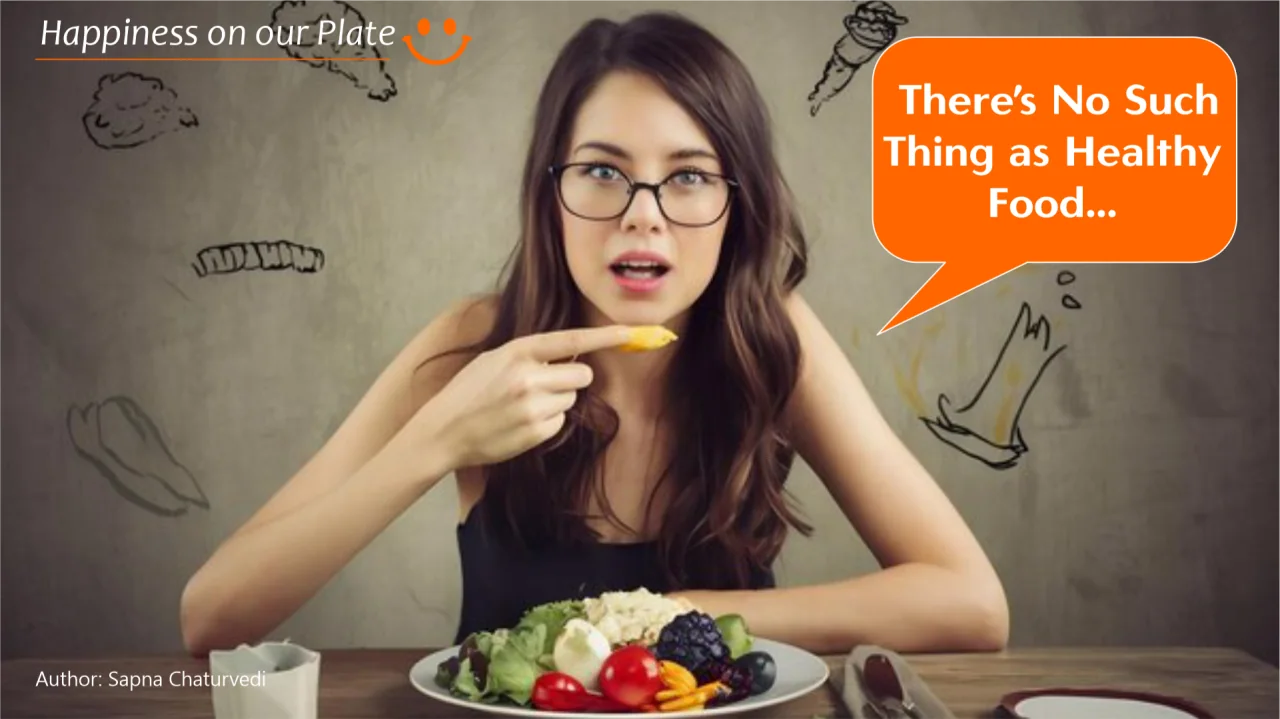
Only a healthy relationship with food, taste, and our own body
We live in a world obsessed with labels—superfoods, clean eating, detox teas, immunity boosters. Food is now ranked, judged, moralized. And somewhere in the middle of all this noise, we began asking the wrong question: Is this food healthy?
But the truth—the one no one told us loud enough—is this:
There is no such thing as healthy food.
Because food, in itself, is not moral. It is not universally good or bad. It is not healing in isolation. Food only becomes nourishment—or stress—based on who is eating it, how it is eaten, when it is eaten, and in what state of mind.
A perfectly “healthy” meal—rich in nutrients, endorsed by experts, ticking every box—can still leave the body bloated, tired, or inflamed if it’s eaten without joy, under stress, or in conflict with one’s gut biology. On the other hand, a so-called indulgent dish, eaten with calm, love, connection, and presence, can be digested with grace and satisfaction.
As Dr. Elissa Epel, a renowned health psychologist, writes:
“Our mindset about the food we eat influences how our body metabolizes it. Stress literally changes how we process calories.”
(The Telomere Effect, 2017)
This isn’t theory—it is physiology. The cephalic phase of digestion, well-documented in medical literature, shows that how we anticipate and emotionally relate to food before even taking a bite affects the entire cascade of digestive processes—from saliva production to enzyme secretion and nutrient absorption.
The food itself hasn’t changed. But the context around it has.
This is why the idea of “healthy food” becomes meaningless without the context of the eater. An avocado may be heart-healthy for one person but may trigger gut discomfort in another. Sprouts may be detoxifying for some but indigestible for someone with a weak digestive fire. Dairy may be a complete food for one and a trigger for chronic sinus issues in another. These contradictions do not cancel each other out. They reveal a deeper truth:
There is no food that is universally healthy. There is only food that is right for you—in this body, in this season, in this moment of your life.
Even Ayurveda, one of the world’s oldest systems of medicine, refused to universalize health. It always asked:
Who is eating?
When?
With what intention?
With what balance of rasa (taste), virya (potency), vipaka (post-digestive effect), and agni (digestive fire)?
Modern science, after decades of pushing one-size-fits-all prescriptions, is beginning to catch up. In 2015, a groundbreaking study published in Cell by Eran Segal and Eran Elinav at the Weizmann Institute in Israel revealed that people can have wildly different blood sugar responses to the exact same foods—even “healthy” ones like brown rice or tomatoes.
“One person’s superfood is another person’s blood sugar spike.”
(Personalized Nutrition by Prediction of Glycemic Responses, Cell, 2015)
The implications are radical: there is no universal chart, no perfect diet, no food that is healthy for everyone.
So what now?
We stop moralizing food and start building a relationship with it. We listen to the body, not the label. We stop chasing what is good on paper and start noticing what feels good in practice. We allow for taste, for culture, for memory, for feeling. We choose meals that feel alive, satisfying, rhythmic, and kind. We honor the part of us that doesn’t want to eat in a lab, but in a home.
Because nourishment was never just a number. It was—and still is—an experience.
“The food you eat can be either the safest and most powerful form of medicine, or the slowest form of poison.”
— Ann Wigmore
But that medicine or poison is never just in the ingredients. It’s in the rhythm, the intention, the taste, and the trust we place in our own bodies.
There is no such thing as healthy food.
There is only a healthy human being—attuned, aware, connected to their gut wisdom.
There is only a healthy mind, one that pauses before feeding the body, one that listens instead of imposing, one that understands:
Making happy choices for our own body is not a luxury—it is our primary responsibility.
Because this is your body. Your gut. Your life.
And if there is no joy on your plate, no flavor in your bite, no trust in your gut—
then no superfood, no supplement, no meal plan will ever make you feel whole.