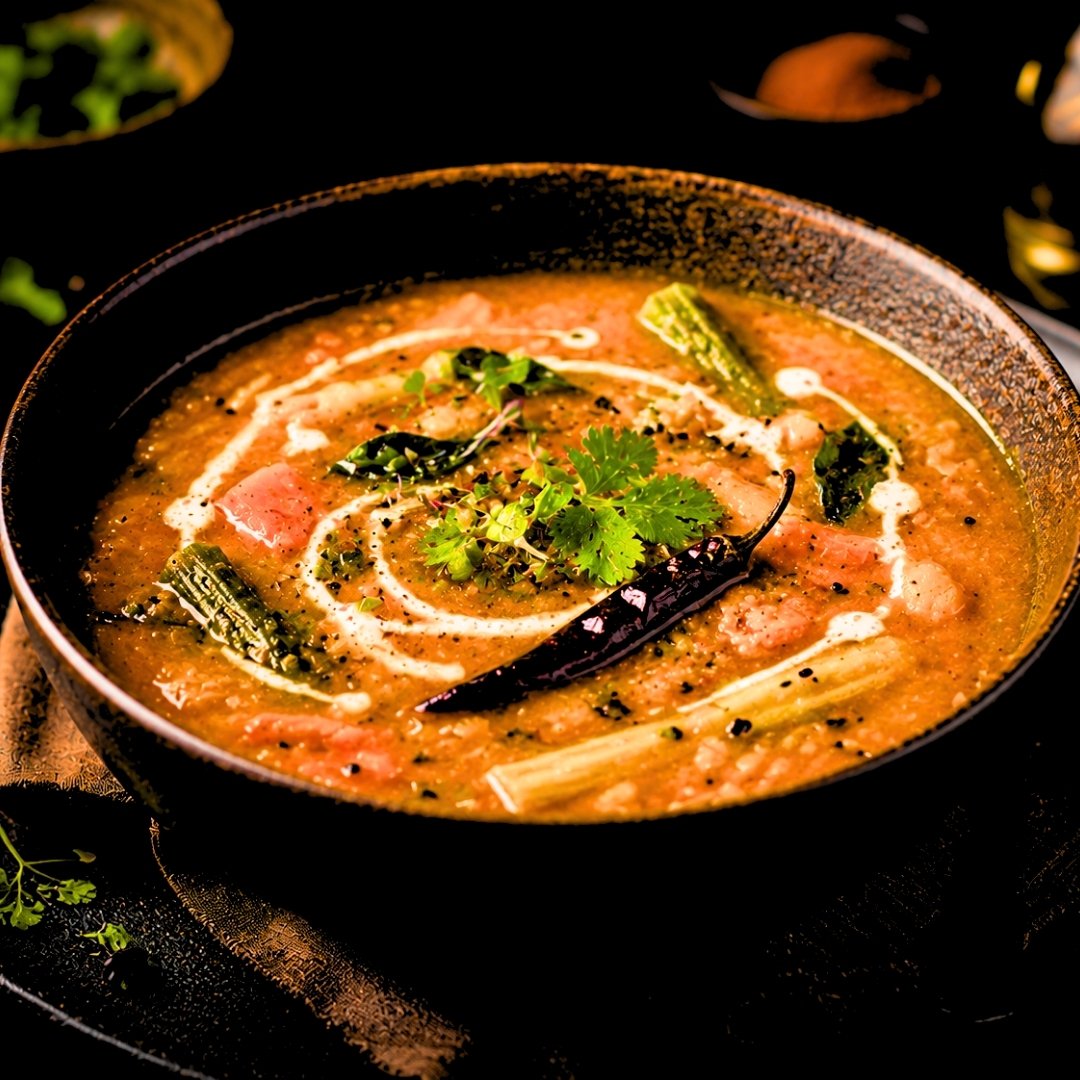
The server at the mess did not ask. That was the whole beauty of him.
He came down the row with a steel bucket hooked on one arm, ladle in the other, and he watched the leaves the way a farmer watches the sky. A crater forming in someone’s rice. A leaf gone dry at the edges. He did not wait for a raised hand. The ladle dipped, tipped, and moved on — a second helping, a third, a fourth, delivered without eye contact, without ceremony, without the faintest arithmetic, from a masala built of 41 ingredients he had never once had to think about. Nobody said "are you sure?" Nobody said "again?" Nobody, at any table in that hall, ever felt watched.
That is the dish this article is about. Sambhar — and the particular kind of civilisation that travels with it.
Every food culture has its treasures, but few have a food whose entire personality is generosity, the way sambhar does in kitchens across India. Sambhar is soup enough to pour and meal enough to matter, and somewhere along the way it became the thing that is simply given. At weddings it arrives on the banana leaf before you have finished admiring the leaf. At the mess it returns before you have missed it. At home it is the pot on the stove that answers every crisis of hospitality known to the subcontinent: three unexpected guests, one unexpected uncle, a neighbour’s child who "just ate" and will now eat properly.
Because sambhar forgives everything. Too many people? Add water; the tamarind and the spice hold the line. Vegetables about to turn? In they go; sambhar has never once rejected a vegetable. The rice ran out? Sambhar walks over to the idli, the dosa, the pongal, the plain chapati, and gets along with all of them like a relative who is welcome in every house. It is the least fragile dish we have. It cannot be ruined by abundance because abundance is its native climate.
And so nobody ever guarded it. Think about that. There are sweets locked in tins, fried things counted out per head, delicacies rationed with the solemnity of a treaty. Sambhar was never once locked up. The default answer to "can I have more?" was that you never needed to ask the question.
It is worth peering into the pot to see what makes a dish this confident.
Under the surface of a good spicy sambhar there is a small orchestra — in this masala, forty-one ingredients deep. Tamarind brings the sour spine. Kashmiri chilli brings the colour that makes the ladle photogenic, with red chilli adding a sharper voice behind it. Roasted urad and chana dal thicken and mellow — and here is a fact not many people know: it turns out roasted chana dal carries about 21.6 grams of protein per 100 grams, a genuinely astonishing résumé for something you mostly notice as body and warmth. Mustard seeds crackle in the tadka — the old texts loved that crackle, calling mustard the seed that ignites the digestive fire. Hing does its ancient, invisible work; the Bhavaprakasha Nighantu describes it as the resin that dispels heaviness and moves what is stuck, which is also a fair description of what a good lunch does to a bad morning. Jeera, the classical books say, kindles digestion and awakens taste itself. And ginger — soonth, in its dry, crushed form — was named vishva bheshaja, the universal medicine, in texts written long before any of us were hungry.
Then, underneath, the whispers: cardamom, cinnamon, clove, nutmeg, mace, bay leaf, star anise, nag kesar — each at around a tenth of one percent. Almost nothing on its own. Together, the low warm hum you could never quite name.
Even the numbers behave generously here. The salt in this masala — rock salt, mostly, the kind long used in fasting kitchens, with a pinch of kala namak, which Ayurveda ranks as the best among salts — predicts about 13,796 mg of sodium per 100 grams of the mix. An independent lab measured 13,622. Two different roads, arriving within about one percent of each other. The recipe keeps its word. (And remember the scale: a spoon of masala disappears into a whole pot; the pot feeds the whole table. The mix is the seasoning, never the meal.).
But the chemistry, honestly, was never the point. The point is the sociology of the ladle.
Somewhere in your memory there is a person attached to it. A mother who tipped the last of the pot onto your rice and claimed, unconvincingly, that she preferred rasam anyway. A grandmother who took your "no no, enough" as a regional dialect of "yes." A hostel server whose name you never learned and whose bucket you will remember at seventy. And you had your own signature — more sambhar, less rice; sambhar first, everything else negotiable; the one who drank it from a steel tumbler like it was a beverage, because in some houses it is.
Years later, mustard seeds pop in someone else’s kitchen, curry leaves hit hot oil, and the whole hall comes back — the leaves, the noise, the man with the bucket. Taste crosses the threshold; the outside becomes the inside, and apparently it files everything away.
Here is the thing about all those years and all those refills. Nobody ever counted how many times the ladle came back to you. Not once, not anywhere, not at any table. That was never carelessness. That is simply what home measured like.
So keep one food in your week that is never counted. Not saved for occasions, not portioned, not earned — just made, on an ordinary Wednesday, in a pot slightly too large on purpose, so there is enough to offer before anyone asks. Let sambhar be that food. It has been rehearsing the role for generations.
And share this with the one who refills your bowl without asking and without counting — the bucket-carrier of your particular life. Some tables still know how to be generous. Sit at them often. Be one of them when you can.
Happiness is health. Remember that, and pass it on.