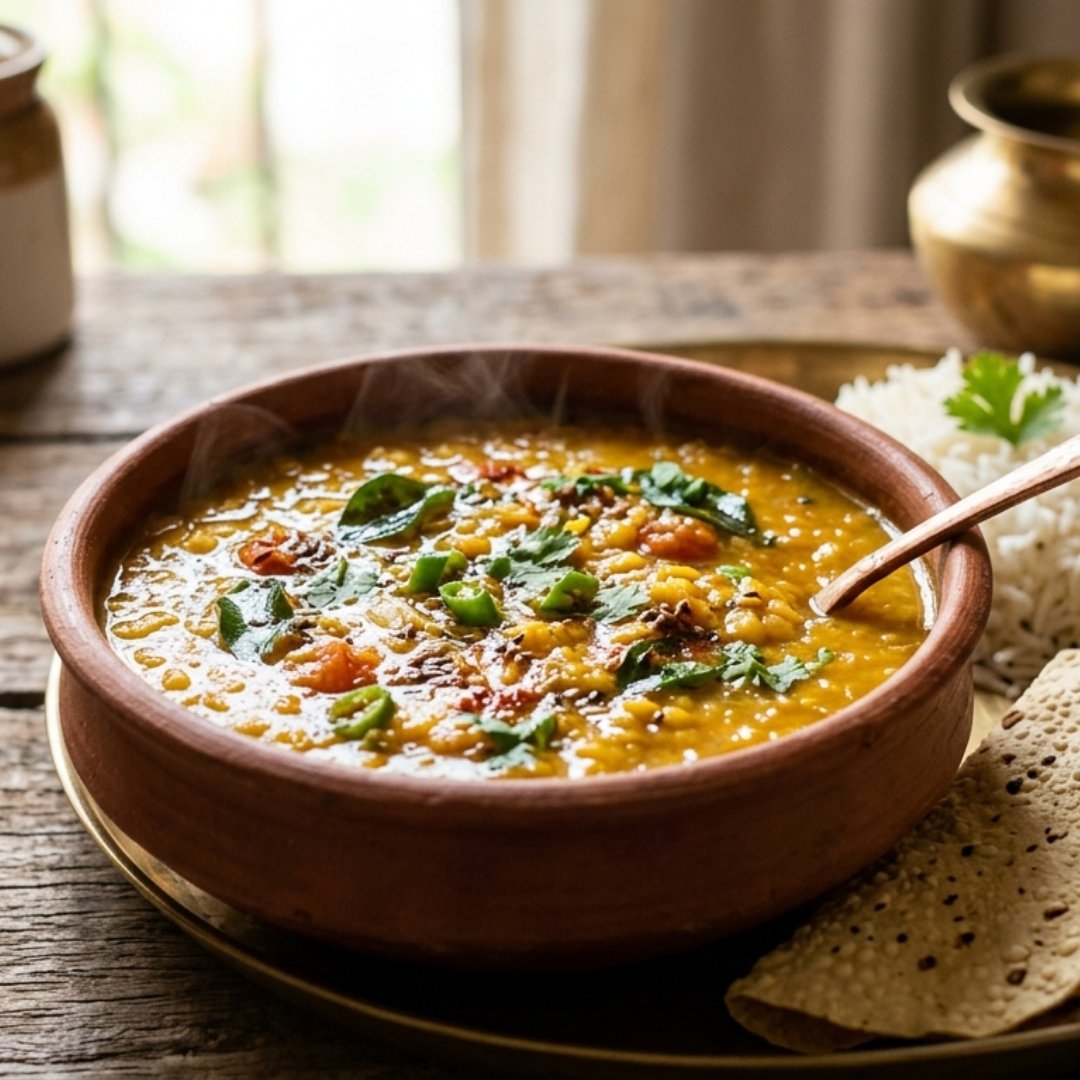
"Nothing special." That is what we say when someone asks what’s for dinner and the answer is dal. We say it the way we might apologise. Kuch khaas nahi — bas dal-chawal. And then we hang up the phone and go eat one of the most quietly loyal things a kitchen has ever produced.
Think of the days dal showed up — starting with the night before the Class 12 board exam.
That night, when nobody in the house could eat anything heavy and somebody’s mother said, "bas thodi si dal le lo," and stood there until it was taken. The evening of the first salary, when the celebration dinner happened at a restaurant — but the stomach, unsettled by too much celebration, was rescued at eleven p.m. by dal and rice at home. The sick days, every one of them, when the world shrank to a bed and a bowl and someone’s hand on a forehead. The afternoon the wedding guests finally left, the fridge groaning with rich leftovers, and the whole exhausted family said, in one voice, "aaj bas dal banao." The last dinner before leaving home for the hostel, the new city, the new country — when it could have been anything, and it was dal, because the person cooking knew exactly what needed to travel in the memory.
Dal was present at everything. And credited with nothing.
It is worth asking where we learned to shrug at it. Nobody ever filmed a dal commercial with fireworks. No slow-motion cheese pull, no billboard, no film hero closing his eyes over a steel bowl of arhar. The foods we call exciting are the foods somebody spent money teaching us to find exciting. Dal never advertised. So we heard silence, and we mistook the silence for dullness. The verdict "boring" was never ours. We inherited it from everything we watched, the way we inherit an accent.
But stand in a kitchen at the right moment and the case collapses.
The dal is done — soft, golden, murmuring on the flame. Now the small pan goes on. Ghee melts and turns fragrant. Jeera goes in and crackles like applause. A pinch of hing blooms. Haldi stains the ghee gold, red chilli deepens it, and then — the moment — the hot tadka hits the waiting dal.
The hiss.
Every Indian who has ever lived within earshot of a kitchen knows that sound. It is the doorbell of dinner. The aroma does not stay in the kitchen; it walks through the house like it owns the place, into the bedroom where someone is pretending to study, into the balcony where someone is pretending to be on an important call. Within a minute, everyone has drifted towards the stove with an air of complete coincidence. Somebody will ask to lick the tadka spoon. Somebody always does.
For something dismissed as plain, dal fry keeps surprising company. In its masala, jeera does the loud crackling — the spice classical Ayurveda prized as deepana and pachana, the kindler of the digestive fire and the awakener of taste. Hing, in the old texts, is the resin that dispels heaviness and moves what is stuck — which any grandmother who ever pressed dal on a sulking child understood without reading a word. Haldi, the Bhavaprakasha Nighantu’s golden root of purification, gives the bowl its sunset colour. Amchoor slips in the sourness of unripe mango — ruchya, the sourness that brightens a heavy dish and wakes the tongue. And beneath them, in tiny whispers of a fraction of a percent each, sit whole roasted spices most eaters will never consciously detect: cardamom, clove, cinnamon, black pepper, star anise, nutmeg, mace, bay leaf. Almost nothing individually. Together, the low hum under the comfort.
Even the humble players are quietly better than their reputation. The roasted dhania in the mix carries about 10.7 grams of protein per 100 grams by the Indian food composition tables; red chilli powder, of all things, about 12.7. Nobody hands out awards for this. Dal’s entire supporting cast works the way dal itself does — thoroughly, invisibly, without applause.
"Taste is the only sense that crosses the threshold. You do not just sense it — you absorb it. The outside becomes the inside.".
Maybe that is why dal, eaten a few thousand ordinary evenings across a life, stops being a dish at all. It becomes the baseline of us — the flavour our body files under home, safe, someone is looking after you. Generations before us made the same bowl and said the same "nothing special" over it, and were held together by it just the same.
And notice what people do around it. Watch a family at dal-chawal. One person makes a neat volcano of rice and floods the crater. One mixes everything into a democratic mush and defends the method with genuine passion. One saves the tadka’s darkened chillies for last like a secret. Someone announces they are full and then asks whether there is more dal — not food, specifically dal — and someone at the stove smiles, because being asked for more dal is a compliment with no ceremony attached.
Here is the thing we owed it all along: dal never needed to be interesting. It needed to be there. And it always was — exam night, sick day, first salary, last night home.
So no, it does not need rescuing with an occasion, and it does not need to be dressed up as a festival dish. Turn it the other way instead. Let the tadka hiss be the small daily fireworks. Put the good bowls out on a Wednesday. Call everyone to the table for "nothing special" and watch how quickly the nothing fills the room. The everyday meal was never the pause between celebrations. It was the celebration, arriving so regularly we stopped noticing.
Share this with the friend who calls dal boring — from every Indian kitchen that quietly raised us on it. Better still, eat a plate of dal-chawal together this week, on the most unremarkable day you can find. The people who made our dal did not wait for occasions, and neither should we. Kya pata kal ho na ho.
Happiness is health.